


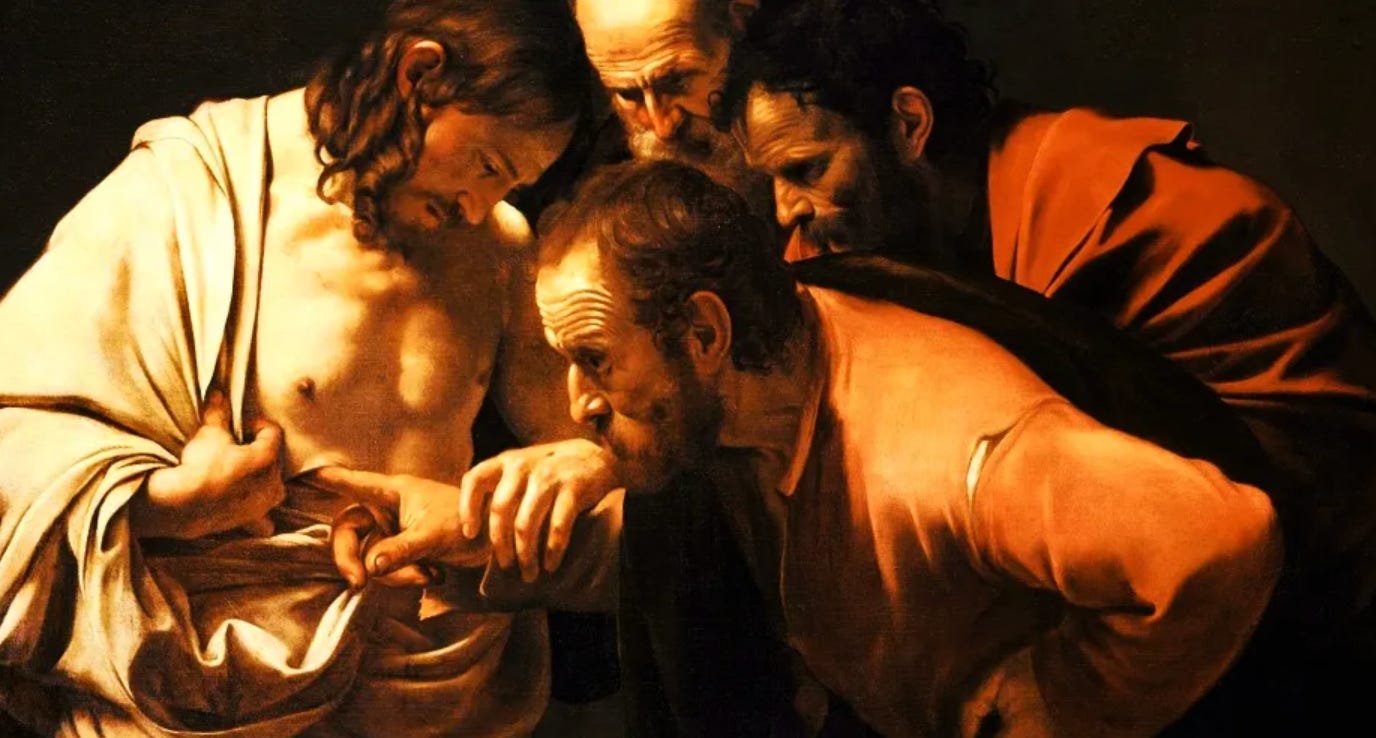
There is something deeply striking in today’s Gospel: when Christ rises from the dead, He does not hide His wounds.
He could have. He has passed through the grave and shattered its power. And yet when He comes to the disciples, He does not appear as though Good Friday never happened. He shows them His hands. He shows them His side.
The wounds remain.
That matters, because it tells us something about the Christian life that modern people often resist. We are tempted to think that holiness means appearing unscarred. We imagine that strength means smoothness, polish, invulnerability. We want resurrection without memory, victory without cost, glory without wounds. But Christ does not return that way. He returns victorious through His wounds, not apart from them.
And that means we need not be ashamed of ours, when we offer them to Christ.
So many Catholics spend enormous energy trying to conceal what has hurt them: failures, betrayals, doubts, humiliations, sins forgiven but remembered, griefs never fully healed. Yet the Risen Lord evangelises by showing His wounds. He does not display them as signs of defeat, but as trophies of love. The very marks of His suffering have become the proof of who He is.
The same can be true, in a lesser but real way, for us. Honest Christians are often more convincing than impressive ones. A man or woman who can say, I have suffered; I have failed; I have sinned, I have doubted; but Christ loves me and I love Him, will usually speak more powerfully than someone determined to project perfection. We do not have to parade our wounds theatrically. But neither do we have to hide them as though grace were ashamed to work through damaged things.
The Church does not spread by the testimony of the flawless. She spreads by sinners redeemed.
Then comes another extraordinary detail. Christ breathes on the Apostles and says: Receive ye the Holy Spirit: whose sins you shall forgive, they are forgiven them: and whose sins you shall retain, they are retained.
This is no casual gesture. It has the unmistakable echo of Genesis, when God forms man from the dust of the earth and breathes into him the breath of life. In the beginning, God breathes life into Adam. Here, in the upper room, the Risen Christ breathes new life into His Apostles. A new creation is underway.
