


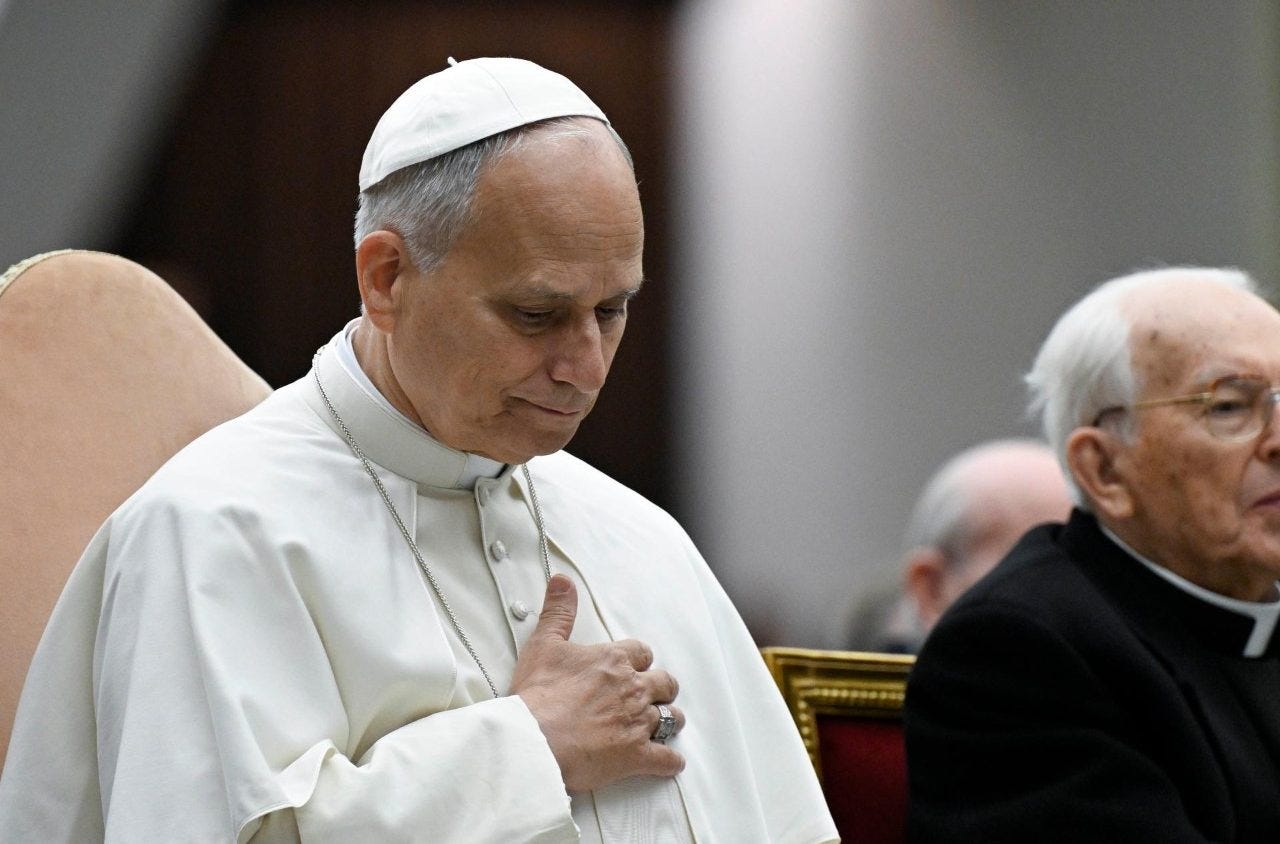
When Pope Leo asked “How long, O Lord?” after the deaths of a mother and daughter in Gaza, he used words which Scripture has preserved for people whose suffering has outlasted their capacity to explain it. The Pope wrote these words after learning that Maysa Khader Ibrahim Abu Daoud and her daughter, Mary Hafez Michel Najjar, had been killed in an Israeli airstrike on a residential building in Gaza City. The two Greek Orthodox women had found another place of refuge and were trying to rebuild their lives. Five civilians were reportedly killed and others were seriously wounded.
Pope Leo assured Fr Gabriel Romanelli, parish priest of Gaza’s Holy Family Catholic Church, that he was praying for the dead, their families and the whole community. He also thanked the priest for remaining alongside people who want to live in peace.
The question posed by the Pope belongs, of course, within prayer, even when it sounds painfully close to protest. It addresses God from the place where consolation has failed and asks whether the darkness will ever end.
I have written before about Hagar, Naomi and the loss of my own daughter Ruth in 2009. Returning to those passages now, I am struck by how much room Scripture gives people to speak before they understand. We sometimes behave as though faith requires us to produce a reassuring conclusion whenever suffering enters the conversation. The Bible allows the wounded person to remain wounded while speaking to God.
Hagar’s encounter in Genesis gives us the name El Roi, the God who sees me. She is a slave woman fleeing mistreatment, far from security and from anyone whose power she can trust. God addresses someone whom others have treated as expendable, her suffering has not escaped His attention.
Yet we must handle that assurance carefully. Being seen by God cannot be reduced to a promise of immediate deliverance, still less used to explain why one person survives and another dies. Hagar’s story tells us something about God’s regard for the afflicted, but, importantly, it does not give us a timetable for His intervention. When we speak to someone enduring terrible suffering, our confidence that God sees must deepen our responsibility to act, listen and remain present.
Naomi’s words are more difficult still. Having lost her husband and sons, she asks to be called Mara, that is, bitter, and she says that she has returned empty. How familiar these descriptions are to me and how I still feel that hollow, empty, bitterness deep in the pit of my stomach. Scripture records Naomi’s accusation against the Almighty without tidying it into the language we might prefer a grieving believer to use. Her faith has become a wounded relationship and she speaks from within that wound.
