


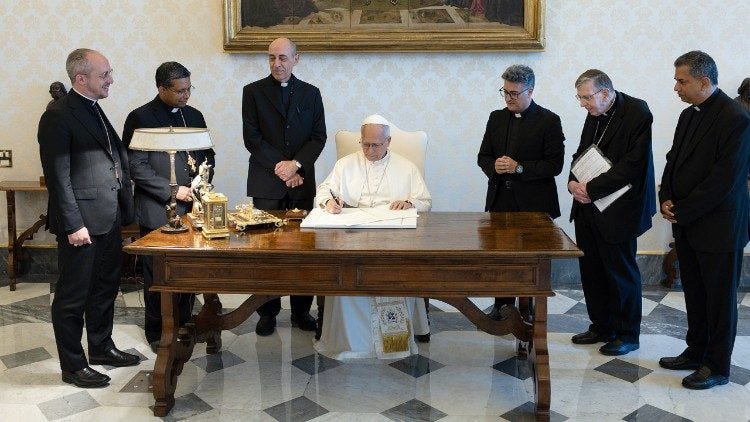
Last Wednesday, the Vatican released A Journey of Hope: Sixty Years of Interreligious Dialogue and Fraternity in the Light of the Conciliar Declaration Nostra Aetate, published jointly by the Dicastery for the Doctrine of the Faith, the Dicastery for Promoting Christian Unity and the Dicastery for Interreligious Dialogue (you can read it in full on the Vatican website here).
Importantly, this is not merely an unofficial study document. Leo XIV approved the Note on 22 June 2026 and ordered its publication, with his approval recorded ex audientia at the end. The expression means that the approval was given during an audience with the Holy Father. In other words, Leo has authorised its publication and publicly associated his pontificate with its teaching. It is a Note rather than an encyclical, apostolic exhortation or declaration of the Dicastery for the Doctrine of the Faith. Papal approval ex audientia confirms that the Note was issued with Leo XIV’s knowledge and authority, but it does not necessarily mean that he has formally made every formulation his own as an act of the papal Magisterium, particularly when the approval was not given in forma specifica. Nevertheless, the document cannot reasonably be dismissed as three Vatican departments freelancing. It is an official, papally approved expression of the Holy See’s present theological and pastoral approach to Nostra Aetate.
The document is doctrinally more careful than much of its early presentation on social media would suggest, but it is also theologically uneven. Its explicit Christology provides a strong orthodox interpretative key, while its weakest passages occur where the vocabulary shifts from Christology and soteriology into the more elastic language of fraternity, encounter, otherness, mutual enrichment and dialogue.
Perhaps most significantly for assessing Leo XIV, this is not merely a retrospective celebration of Vatican II. Leo has formally approved a document which presents Pope Francis’s programme of fraternity and interreligious encounter as part of a continuous trajectory extending from Paul VI through John Paul II and Benedict XVI to Francis and Leo himself. At the same time, the Note deliberately surrounds that programme with considerably stronger language about doctrinal identity, Christ’s unique redemption, evangelisation and the rejection of syncretism than one might imagine from the extracts currently circulating widely on social media. It is therefore an official, papally approved reaffirmation of Nostra Aetate for the present day, defending interreligious dialogue and fraternity while attempting to anchor them in the uniqueness of Christ, the missionary nature of the Church and the rejection of religious relativism. These are all questions at the centre of the present controversy within the Church and are especially pertinent in the aftermath of the SSPX episcopal consecrations at Écône.
Although the Vatican II Declaration Dignitatis Humanae probably represents the clearest doctrinal fault line, Nostra Aetate forms another important part of this dispute. The SSPX argues that the assertion in Dignitatis Humanae of a civil right to religious liberty cannot be reconciled straightforwardly with the nineteenth and early twentieth-century Magisterium, particularly Gregory XVI’s Mirari Vos, Pius IX’s Quanta Cura and Syllabus of Errors, and Leo XIII’s teaching concerning the Catholic state. Its objection is not simply to the toleration of false religions for the sake of the common good, since traditional theology already allowed for that. It concerns whether immunity from coercion in religious matters constitutes a natural right extending even to the public manifestation of religious error. Defenders of Dignitatis Humanae reply that the Council did not recognise a moral right to religious error, still less declare all religions equally true, rather it recognised a limited civil right to immunity from coercion, grounded in the dignity of the human person and the fact that faith must be embraced freely. They argue that the earlier condemnations were directed principally against religious indifferentism and an unlimited freedom founded upon individual autonomy, whereas the Council addressed the narrower question of whether the state may compel or prevent religious acts within the requirements of a just public order. Dignitatis Humanae itself insisted that it left intact traditional Catholic teaching concerning the duties of individuals and societies towards the true religion and the one Church of Christ. The dispute is therefore whether this distinction represents an authentic doctrinal development or an attempted reconciliation which does not finally resolve the contradiction.
Nostra Aetate represents another dimension of the problem, particularly regarding Judaism, Islam and the positive assessment of elements found within non-Christian religions. Strictly speaking, however, the SSPX’s wider objection to ecumenism is directed at Unitatis Redintegratio and Lumen Gentium as much as, and arguably more than, Nostra Aetate. Its concern is that separated Christian communities and non-Christian religions appear to have acquired a positive ecclesial or salvific significance which traditional Catholic theology had not previously attributed to them in the same way.
Memorably, during our discussion with Bishop Athanasius Schneider, he raised Lumen Gentium §16, which says of Muslims that “together with us they adore the one, merciful God, mankind’s judge on the last day”.
Bishop Schneider explicitly rejects this phrasing, regarding its apparent implication that Catholics and Muslims participate in a common act of adoration as highly ambiguous and theologically erroneous. His objection rests upon the distinction between a natural recognition of God, attainable through reason, and the supernatural knowledge of God given through revelation and faith in Christ. Muslims may intend to worship the one Creator, but they do not know or worship him through the Trinitarian revelation, divine adoption and sacramental life given in Christ. Schneider therefore argues that placing Muslim and Christian worship on the same plane risks obscuring the radically distinctive filial relationship with God into which Christians are incorporated through Christ.
At the deepest level, these apparently distinct SSPX objections converge upon the doctrine extra Ecclesiam nulla salus: outside the Church there is no salvation. The Society argues that the cumulative effect of Lumen Gentium, Nostra Aetate and Dignitatis Humanae has been to obscure, qualify or practically abandon the necessity of the Catholic Church for salvation. If non-Catholic religions are presented positively, their adherents appear to worship God alongside Catholics, and their public propagation is protected as a natural right, the SSPX asks what substantive meaning remains in the claim that the Church is the unique ark of salvation. Its accusation is therefore not merely that individual conciliar formulations are ambiguous, but that together they disclose a fundamentally altered understanding of the Church’s relationship to religious error and the salvation of those outside her visible boundaries.
I examined this deeper accusation back in March, as the SSPX consecrations loomed. I included a clip from a homily by SSPX Bishop Bernard Fellay in which he asserted that the Vatican no longer teaches extra Ecclesiam nulla salus, before demonstrating from the relevant documents that this is simply not the case.
The SSPX warning has real force insofar as the possibility of salvation outside visible Catholic communion has too often been transformed into the assumption that sincere adherence to almost any religion is itself salvific, rendering conversion, baptism and incorporation into the Church practically unnecessary. Yet its polemic can run into the opposite error by treating extra Ecclesiam nulla salus too mechanically, as though visible membership and correct profession were sufficient for salvation, while a person who truly loves Christ and seeks to obey him could be condemned merely because, through ignorance or misapprehension, he has not recognised the Catholic Church as the Church Christ founded. Vatican II perceived this genuine tension. It did not deny that all salvation comes through Christ and possesses an essential relationship to his Church; rather, it attempted, however imperfectly, to explain how that doctrine applies amid the complexities of conscience, culpability, invincible ignorance, implicit desire and the hidden operation of grace. The Council’s formulations may subsequently have been stretched towards indifferentism, but the theological and pastoral questions with which it wrestled cannot responsibly be resolved by repeating the ancient formula without also explaining its full meaning.
The SSPX criticism of Nostra Aetate might be summarised in the form of a question: how can the Church move from warning against religious indifferentism and common religious activity with false religions to speaking positively about interreligious dialogue, the truths found within other religions and the continuing theological significance of Judaism without changing the underlying ecclesiology and soteriology?
A Journey of Hope does attempt to answer this. Indeed, its authors appear conscious that they are addressing precisely this problem. Paragraph 3 almost formulates it explicitly: “How can fidelity to Christian identity be reconciled with a sincere openness to otherness?”
The Note’s answer is essentially that the Church has changed her mode of engagement with other religions without changing her doctrine concerning Christ, revelation and salvation. Such a development was not without reason. The unprecedented proximity of religions in an increasingly interconnected world, the collapse of the old confessional political order, the experience of religious violence and persecution, the legacy of colonialism and above all, the catastrophe of the Shoah required the Church to examine not only what she taught about other religions, but how Christians had spoken about and treated their adherents. Dialogue also represented a retrieval of principles already present within Catholic tradition: the dignity of every person created in the image of God, the truths accessible through natural reason, the “seeds of the Word” discernible among the nations, the universal operation of divine providence and the insistence that faith, by its nature, cannot be coerced.
Such a change is possible because doctrine and its pastoral application are not identical. The truth that Christ is the sole Redeemer does not dictate hostility towards those who do not yet recognise him; on the contrary, Christian charity may require patient listening, cooperation for the common good and the removal of historical prejudices which obstruct the reception of the Gospel. A new mode of engagement need not therefore imply a new doctrine, provided that dialogue remains governed by the truths it is intended to communicate and ultimately ordered towards Christ. That is the central claim running through A Journey of Hope. The important question is whether the Note successfully demonstrates it, or whether the changed pastoral posture has begun quietly to alter the doctrinal content it claims merely to express in a different way.
