


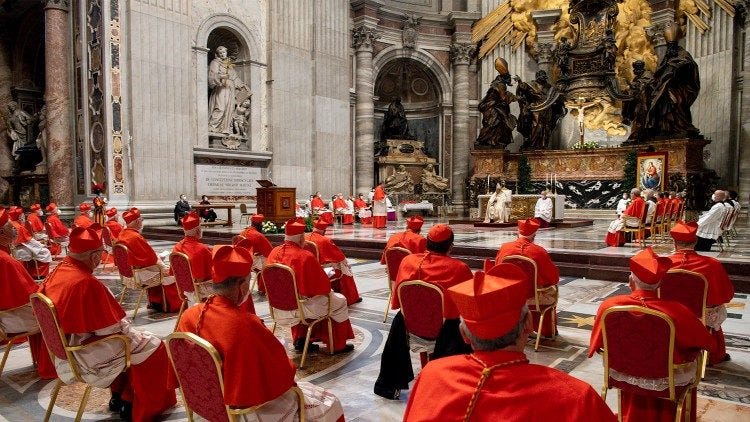
Pope Leo XIV has convened an Extraordinary Consistory of Cardinals starting tomorrow January 7–8, 2026. This is the first consistory of his pontificate, bringing the entire College of Cardinals to Rome for substantive discussion rather than ceremonial observance. This gathering immediately following the conclusion of the Jubilee of Hope is a clear a shift in style and governance from his predecessor, even as much of the official agenda echoes the language and priorities associated with Pope Francis’s papacy.
The Agenda Has Arrived — and It Looks Familiar
The Vatican’s communications, now codified in an official programme shared with cardinals and reported by Il Giornale, outline a two-day plan centred on reflection, prayer, and structured dialogue. The meeting begins with an opening session and continues through a series of working groups, group reports, free interventions, and a papal lunch, concluding with prayer and a Te Deum. Cardinals will meet in three sessions over two days with opportunities for both small-group work and plenary contributions.
According to the accompanying letter from the Pope, cardinals were asked ahead of time to re-read key documents including Evangelii Gaudium (2013) and Praedicate Evangelium (2022), and the consistory agenda explicitly prioritises:
Synodality and Church governance — reflecting the Church’s renewed emphasis on collaborative discernment;
Re-reading Evangelii Gaudium as a foundation for evangelisation and mission;
The reform of the Roman Curia in light of Praedicate Evangelium;
Liturgy and pastoral care, framed broadly in terms of “sound tradition versus legitimate progress.”
This theme selection is unmistakably Bergoglian, the language of synodality, evangelisation, and internal reform has defined Francis’s papacy and remains prominent in Leo’s call. Yet the form, structure, and very act of forcing a broad consultation with all cardinals breaks with the more informal, closed-circle advisory model that characterised the previous pontificate.
Bergoglian Texts, Leonine Method
One striking feature of the published agenda is its explicit invitation for cardinals to reread Evangelii Gaudium (2013) and Praedicate Evangelium (2022). This choice immediately situates the consistory within the conceptual universe of Pope Francis. The language is familiar: missionary conversion, synodality, decentralisation, processes over outcomes, and a Curia reordered around evangelisation rather than doctrinal oversight. On paper, the agenda could almost have been issued a decade ago.
Yet here an important distinction must be made. While the texts are Bergoglian, the act of convening an extraordinary consistory itself is not.
Evangelii Gaudium: Vision and Its Discontents
Evangelii Gaudium is the programmatic manifesto of the previous pontificate. Cardinals rereading it today are likely to focus less on its rhetorical aspirations and more on how its principles functioned in practice.
The exhortation calls for a missionary conversion of the Church, a turning outward from institutional self-reference toward evangelisation. Few cardinals would contest this aim. The harder question is whether, in reality, this emphasis weakened internal coherence by downplaying discipline, clarity, and stable structures at precisely the moment they were most needed.
More pointedly, Evangelii Gaudium argues for decentralisation, warning that excessive Roman centralism “complicates the Church’s life.” Yet many cardinals experienced the opposite during the Francis years: increased centralisation through motu proprios, rescripts, and dicasterial interventions, especially in matters of liturgy and episcopal governance. The contrast between principle and practice is difficult to ignore and is almost certainly one of the unspoken reasons this consistory has been called.
Equally significant is the document’s emphasis on pastoral primacy and discernment. Doctrine is not denied, but its application is often framed as provisional, contextual, and process-driven. In practice, this approach generated serious confusion, most recently with Fiducia Supplicans, whose reception exposed deep fractures within the episcopate and required repeated clarifications and partial retreats. Cardinals gathering in Rome cannot avoid asking whether a pastoral style that regularly necessitates “clarifications” is, in fact, pastorally effective.
Praedicate Evangelium: Reform Without Consensus
If Evangelii Gaudium provides the vision, Praedicate Evangelium attempts to give it institutional form. The reorganisation of the Roman Curia placed evangelisation at the top of the hierarchy of dicasteries and reframed the Curia as a service body rather than a governing authority.
Here again, the principle is widely attractive. But cardinals are likely to assess whether the reform delivered what it promised. Many bishops report that Rome felt no less interventionist after 2022, particularly in liturgical matters. The claim that the Curia merely “serves” the bishops rang hollow when decisions arrived from above with minimal consultation, often accompanied by tight deadlines and little explanation.
Synodality, meanwhile, was elevated as a permanent style of governance. And yet the College of Cardinals itself, the pope’s traditional senate, was largely sidelined during the Francis pontificate. Extraordinary consistories became rare; major decisions were often announced without prior collegiate consultation. This dissonance between synodal rhetoric and autocratic method is one of the defining paradoxes of the era now under review.
The Irony at the Heart of This Consistory
This is where Pope Leo XIV’s decision becomes quietly radical.
The agenda may speak in Bergoglian terms, but the method is resolutely non-Bergoglian. By convening the entire College of Cardinals for a substantive, multi-day extraordinary consistory, with working groups, free interventions, and collective reflection, Leo XIV is restoring a form of governance that his predecessor largely abandoned.
In other words, synodality is being practised through the very institution that synodality often bypassed.