


There are few subjects more likely to elicit a sense of melancholy among practising Catholics than the question of whether the faith can be successfully transmitted to the next generation. It is a sorrow familiar to countless parents and grandparents throughout the Western world. In parish halls, at dinner tables and after Sunday Masses, the same lament is heard with weary regularity. The children have drifted away. The grandchildren have never entered a church. The chain appears broken.
Against this backdrop, Edward Pentin’s recent interview with Eduard Habsburg arrives as something rather unexpected. It is not a polemic, nor is it another sociological analysis of religious decline. Instead, it is the testimony of a man whose life straddles both history and modernity, a descendant of one of Europe’s greatest Catholic dynasties reflecting upon the enduring question of how faith survives in an age seemingly determined to forget it.
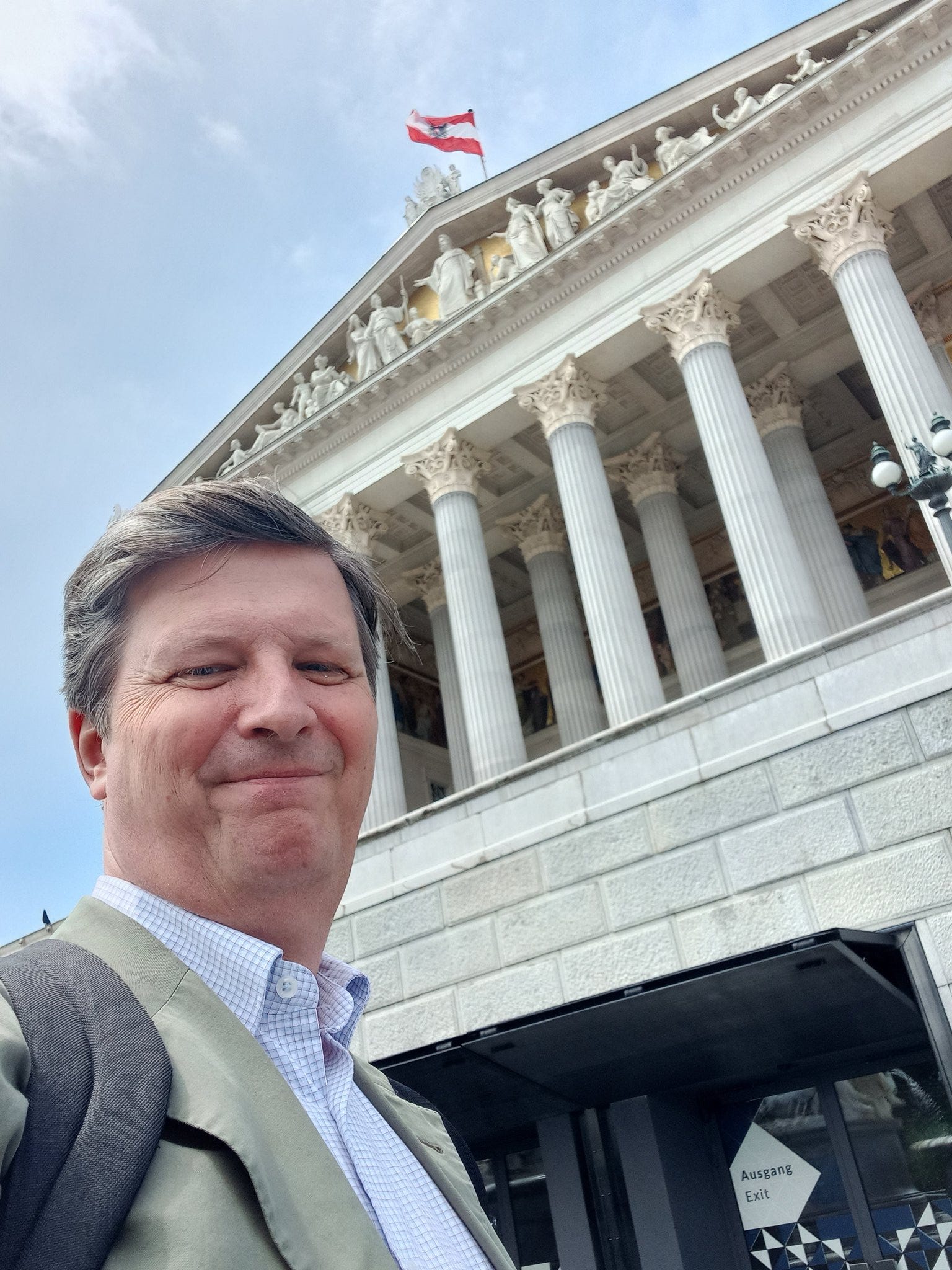
The name Habsburg still carries a certain resonance. For centuries the House of Habsburg stood at the centre of Christendom’s political and cultural life. From the courts of Vienna to the battlefields of Europe, the dynasty was intertwined with the fortunes of Catholic civilisation itself. It produced emperors, kings, queens, patrons of the arts and defenders of the faith. Its story is inseparable from the story of Europe.
Yet Eduard Habsburg is no museum piece, no nostalgic aristocrat mourning a vanished world. Born in Munich in 1967, educated in philosophy and history, he has enjoyed a remarkably varied career. He earned a doctorate in philosophy, worked in television and film production, wrote novels and screenplays, became a prominent public commentator on Catholicism and history and eventually served as Hungary’s ambassador to the Holy See. Many Catholics know him less as a diplomat than as one of the most engaging personalities on social media, where his characteristic wit and self-deprecating humour have made him a uniquely accessible ambassador for the faith.
What makes Pentin’s interview so compelling, however, is not Habsburg’s pedigree or public career. It is his candour.
The occasion for the interview is Habsburg’s new book introducing readers to the Traditional Latin Mass. What is striking is that his journey towards the ancient Roman Rite was anything but straightforward. Like many contemporary Catholics encountering it for the first time, he found the experience bewildering. The unfamiliar language, the silence, the ritual gestures and the apparent lack of explanation left him confused and even frustrated. Just like many of us, it was not love at first sight! Yet something drew him back and gradually, what had initially seemed strange began to reveal its inner coherence. The liturgy ceased to appear as an archaeological curiosity and instead emerged as a profound expression of a theological vision that had shaped generations of Catholics. More importantly, it began to shape his family.
Here the interview touches upon a subject of immense significance. Habsburg explains that his family were already practising Catholics. They attended Mass, prayed together and took their faith seriously. Yet he observed that their encounter with the Traditional Latin Mass brought about a noticeable deepening of their spiritual lives. Prayer became more central. Devotional practices flourished. The Rosary assumed a greater importance. Novenas became woven into the rhythm of family life. Faith ceased to be something compartmentalised and became instead the organising principle around which everything else revolved.
It was impossible to read these reflections without recalling a recent conversation within my own Catenian Circle.
I often find that discussions at meetings eventually turn towards children and grandchildren. It is a subject that reveals both the joys and wounds of Catholic fatherhood. At our most recent meeting one brother spoke of his own children, who no longer practise the faith and who, he told me with evident sadness, are actively hostile towards his continued commitment to it.
He then turned the conversation towards me. “How did you manage it?” he asked. “All your children still practise their faith.” Then came the question. “Did you indoctrinate them?”
“I hope so,” I replied.