


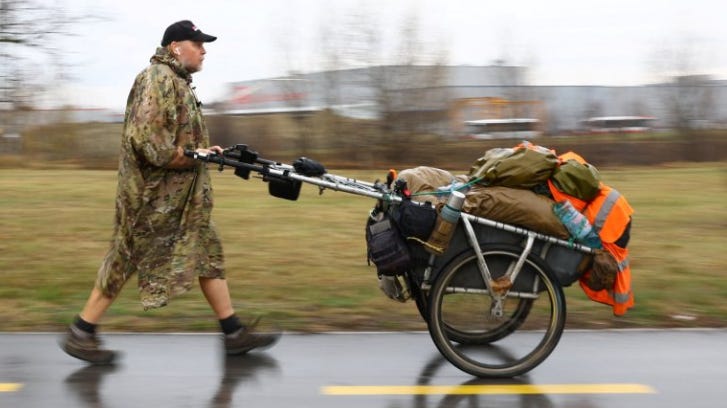
After 28 years walking around the world, Karl Bushby has returned to a hero’s welcome. I have to say this left me scratching my head. I understand that he has displayed extraordinary endurance, but why is no one distressed about the responsibilities he left behind?
“Where have you been?”
Those were the first words Angela Bushby spoke to her son Karl when he finally arrived at her home in Hull on Monday, having spent 28 years walking some 31,000 miles around the world. It was an affectionate joke, uttered through tears at the culmination of an extraordinary adventure, but I cannot help wondering whether there was a hint of hidden steel in her question. Did Mrs Bushby inadvertently ask the most important question of the entire expedition?
Where, indeed, had he been?
While Karl Bushby was crossing continents, surviving deserts, negotiating frozen seas and battling the bureaucracy of international borders, his eight-year-old son was growing up without him. That boy is now a 36-year-old father himself, whose 12-year-old daughter had never met her grandfather in person until this week.
Meanwhile, Britain is celebrating Bushby as a hero. Hundreds gathered to welcome him home, civic dignitaries congratulated him, and even the Prime Minister sent a message praising his courage, resilience and determination. His expedition, we are told, demonstrates what can be accomplished through extraordinary determination and self-belief.
I have to say, this has left me scratching my head. I understand that Bushby has displayed remarkable physical endurance, but why does nobody seem particularly troubled by the responsibilities he left behind? Surely we must distinguish between the capacity to accomplish something extraordinary and the wisdom of choosing to accomplish it in the first place?
Bushby was 29 when he set off in 1998. He had already divorced the mother of his young son, Adam, but divorce does not dissolve the responsibilities of fatherhood. Instead, he embarked upon an expedition governed by two rules of his own making: he would not use transport to advance his journey, and he would not return home until he had completed it. These were not obligations imposed upon him by his country, his employer or some urgent humanitarian necessity. They were rules he chose for himself in pursuit of a personal ambition. The intended journey was considerably shorter, but 28 years passed before Bushby finally returned to Hull.
In a remarkably candid interview with the Yorkshire Post, Adam described the extraordinary circumstances of his upbringing. He expressed genuine pride in his father’s accomplishments but acknowledged that there were moments in his childhood when he simply needed his dad. Bushby missed his son’s education, birthdays, Christmases, celebrations and countless ordinary milestones. Father and son remained in contact through letters, telephone calls and eventually video calls, and Adam travelled to see him on a handful of occasions. But how can these fleeting encounters replace the daily presence of a father during the formative years of a child’s life?
I find that trade-off profoundly sad for both of them. My own experience as a father, and now recently a grandfather, is immeasurably more important to me than any holiday, excursion or adventure I could conceive of. I cannot comprehend trading fatherhood for anything else, let alone a solitary journey around the world. How does a child make sense of knowing that his father has chosen to spend his life pursuing an extraordinary personal ambition rather than being there to watch him grow up?
We should not presume to know the full extent of Adam’s feelings. He has spoken generously of his father and clearly loves him. But his generosity should not prevent us from examining the moral choices that made such an unusual childhood necessary, particularly when Bushby himself appears perfectly conscious of the selfishness involved.
In an October interview with The Guardian, he acknowledged that his life over the previous 28 years had been entirely centred upon himself, with the expedition taking precedence over his personal relationships. Perhaps most astonishingly, he admitted that he did not return home when Adam was seriously injured in a motorcycle accident. He also said that he had accepted from the outset that he would not return for either parent’s funeral should they die during his expedition.
Consider that for a moment. Here is a man being widely celebrated for his extraordinary determination who apparently considered completing a self-imposed challenge more important than returning to his family during moments when they might desperately have needed him.
His explanation is equally revealing. Speaking after his arrival in Hull, Bushby suggested that completing the expedition might make him of greater value to his son than returning home. What a bizarre perspective. I genuinely struggle to understand how that argument can be sustained.
