


Written for Catholic Unscripted by C.Huxley
This week a by-election in the constituency of Makerfield, a semi-rural area sandwiched between Manchester and Liverpool, is dominating the British headlines. Ordinarily it would be of little interest, as the Labour Party will continue to enjoy a huge majority in Parliament regardless of the outcome. But this time it is different. A Labour win could result in a challenge to Sir Keir Starmer’s premiership, while a Reform UK win, in this once safe Labour seat, will be seen as a bellwether heralding the collapse of Labour into obscurity. It has been a century since we last experienced such a cataclysmic shift, after the Representation of the People Act 1918 changed voter demographics so dramatically that Labour displaced the Liberals as the principal party of the left, such that the Liberals would never again form a government.
But there is another reason this by-election is interesting. It is the first time that the new party Restore Britain will put forward a candidate, and it seems every arm of the British establishment is vehemently against them. They are being treated as Reform UK mark 2 and are tarred with the same accusations once levelled at them. The Times published the results of a small telephone poll indicating that Restore is splitting the right-wing vote and preventing a Reform victory. The Daily Mail published a hit piece describing the party as the ‘new home for neo-Nazis’ because a young party member attended a remigration summit in Europe. The Telegraph claims that the party’s leader, Rupert Lowe, sees every government problem as ‘malign’, thereby hinting that he is an irrational conspiracy theorist. Terms like ‘ethno-nationalist’ and ‘racist’ have been flung at them, despite there being no racial elements to any of their policies.
Restore Britain is far more than a populist anti-immigration party. The clue is in the name. The party promises to restore to the British public something that has been lost. This is touching people at a visceral level. Even those too young to remember what Britain was before its descent into a quagmire of sclerotic bureaucracy, over-taxation and demographic instability driven by unprecedented population churn, have been heard saying ‘I just want my country back’.
We British have an innate sense of what our social contract should feel like. As Edmund Burke understood, our society is held together not merely by laws and institutions, but by customs, traditions and understandings passed from one generation to the next. Like a Canada goose using its innate sensory compass to navigate a migration route learnt from earlier generations, we may not always be able to explain those inheritances, but we know when we have strayed from them. What we are living with now is a poor shadow of our birthright and it is causing a primal wound. While all parties make appropriate noises from time to time, Restore Britain is the only party that is unequivocal in acknowledging this wound and offering practical ways to heal it.
The British social contract traces its roots back a thousand years to Anglo Saxon England, when the folk-right (customary laws of the common people) were the bedrock of our legal system, giving us the grassroots-up model to jurisprudence that became the Common Law. This is fundamentally different in character from top-down legal systems like the Napoleonic Code. In our tradition of law, everything is legal unless expressly made illegal. Consequently, we have traditionally focussed on the freedom of the individual, rather than their civic duties.
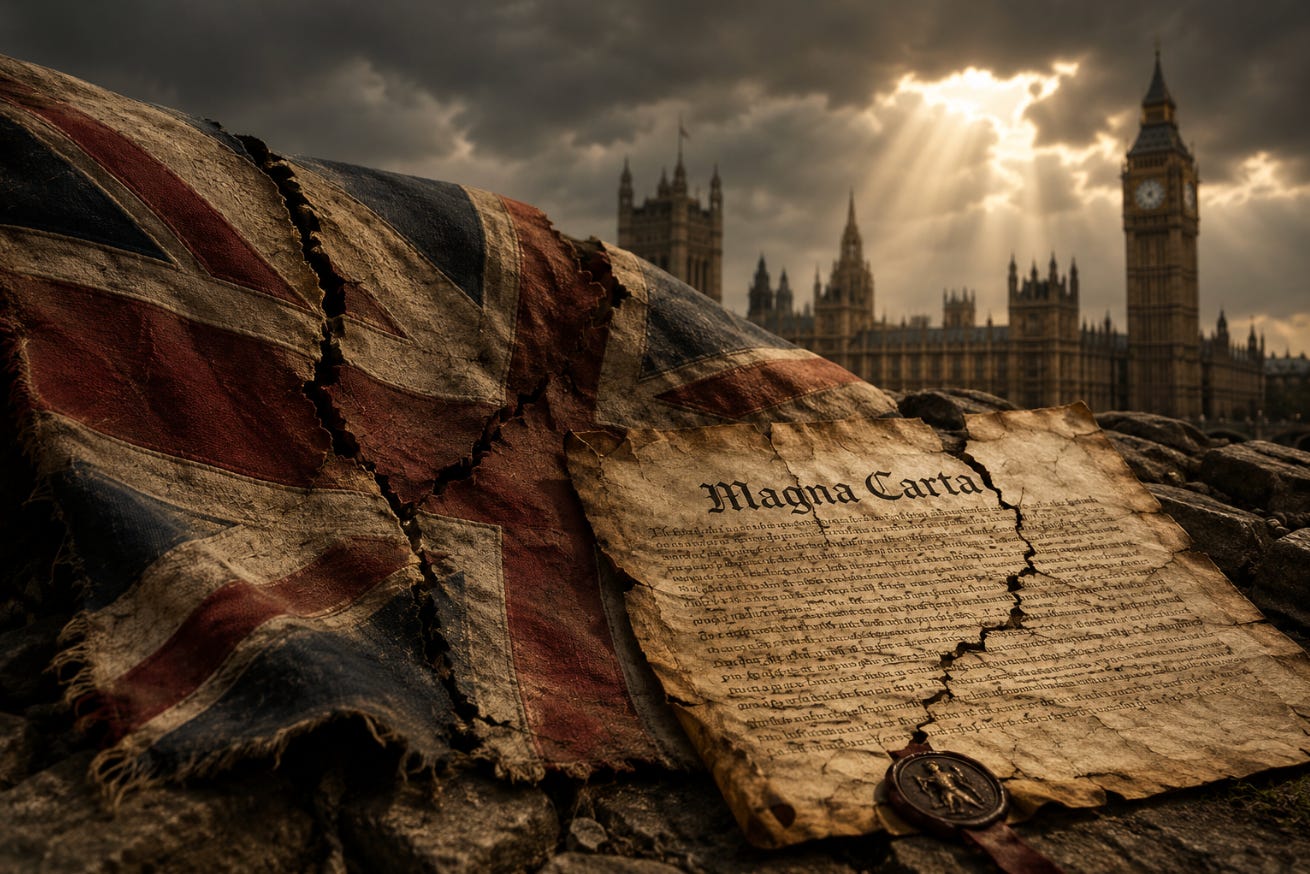
It is no coincidence that Magna Carta, with its requirement that the Sovereign operate within the law, that everyone have access to due process and a fair trial, and that taxation must have consent, should emerge from a people with a history of folk-right. The ordinary English peasant enjoyed relative freedom and, should he face criminal charges, the right to a jury of his peers. Today our Justice Secretary, David Lammy, wishes to take this ancient liberty away from us, except in the most serious cases, on the spurious grounds that removing the jury would speed up the court backlog.
Atop the Old Bailey in London there is a giant golden statue of a woman with scales for weighing evidence in one hand and a sword for authority in the other. She is Lady Justice, one of the most famous legal symbols in the world, dating back to Ancient Rome and symbolising the reliable impartiality of the justice meted out beneath her. The social contract demands that we trust that this is the case, yet the principle of equality before the law has been systematically undermined in recent decades through the iterative impact of successive pieces of legislation that prioritise modern civic ‘human rights’ over the ancient natural rights and liberties upon which our legal system was founded.
The Human Rights Act 1998 and the Equality Act 2010 might sound as if they would reinforce our age-old tradition of equality before the law, but they do the precise opposite. Rather, they are the embodiment of Animal Farm, when the farm animals are told ‘all animals are equal, but some animals are more equal than others.’ In modern Britain, the state has legislated to provide protections that make specific minorities ‘more equal’ than the majority. These carve-outs reflect contemporary concerns and the implications were so ill thought through that no consideration was made for the incompatibility of competing rights claims from different minority groups. Women’s rights to privacy were pitted against transgender rights to inclusion. The result of this was that a previously common-sense understanding of UK workplaces legislation regarding the provision single sex lavatories and changing facilities, went all the way to the Supreme Court, as an employer tried and failed to argue that male-bodied transwomen were entitled to use the same facilities.
The government was aware from the beginning that these carve-outs hurt the general population. The Senior Law Lord who oversaw these changes, Lord Bingham, told the Law Society in 2005 that it was natural that these changes ‘should provoke howls of criticism by politicians and the mass media’ who ‘generally reflect the majority opinion’. In another speech in 2008 he agreed that our human rights legislation is ‘in one sense undemocratic in that it is counter-majoritarian’.
Twenty years ago, the implications might have seemed abstract and victimless, but the downstream effect has been pernicious. We have seen the implementation of preferential treatment for minorities at every level in our society, from student work experience opportunities to Royal Air Force recruitment. Last year the Sentencing Council published guidance that triggered criticism from MPs because it recommended pre-sentence reports in certain cases involving ethnic minority offenders.
Policing in Britain was founded on the Peelite principle that ‘the police are the public and the public are the police’. This was very much within the English tradition that trust in public institutions is established through the people’s consent and participation. Today, accusations of two-tier policing have become a daily occurrence and are no longer deniable. Most upsettingly, we have recently seen footage of Hampshire police’s rough-handling and arrest of the dying teenager Henry Nowak contrasted with their pastoral concern for the wellbeing of his murderer Vickrum Digwa. We also heard that Hampshire police tried repeatedly to stain Henry’s reputation with false accusations of racism. The response from the state was to blame Reform UK’s Nigel Farage for using the term ‘cold rage’, as if those who express horror are more culpable than a system that fails a teenager in need.
The inversion of our social contract has become deadly. While other parties indicate small commitments to change, Restore Britain has gone full throttle: demanding the abolition of all ‘two-tier guidance’, the sacking of all senior police leaders and the abolition of all DEI roles. Theirs is a scorched earth approach on the grounds that because police promotions have been dependent on adherence to DEI, an entirely fresh start is required.
Since the Middle Ages, long predating our modern democracy, England has had a representative government, whereby everyone in the land was deemed to be represented in parliament either in person or by their representative. While voting was restricted to land-owning or affluent men, nevertheless, they elected Knights of the Shire and Burgesses to send to Parliament. This might sound terribly Tolkien-esque, but these representatives formed what is now called the House of Commons, upholding the interests of their local area, approving taxes and making laws.
In recent times, this direct relationship with our representatives in parliament has been undermined by party headquarters parachuting in their own chosen shortlist of potential candidates, often with no relationship to the local area. The result is that the MP’s loyalty more naturally lies with the party, rather than with the people they are supposed to represent. This is not merely an administrative problem. As Roger Scruton observed, people are most willing to trust institutions when they feel a sense of ownership and attachment towards them. The further decision-making is removed from local communities, the more politics becomes something done to people rather than by them. Restore Britain is quietly rectifying this by building a grassroots movement in which branch members will have more autonomy to set local priorities and choose their candidate for MP.
Perhaps more egregious has been the undermining of Parliament itself. The Palace of Westminster is where our elected representatives are meant to wield power on our behalf. They are meant to have the power to enact and dissolve legislation, critique it in debate and vote against it if it does not serve their constituents well.
It may therefore come as a surprise to hear that, if you watch Prime Minister’s Questions today, you will not hear serious engagement of matters of state. Not only does Starmer refuse to answer challenging questions, but there is often little of magnitude to discuss. The Mother of Parliaments is reduced to a mothers’ meeting, hearing tales of small fundraisers and free school meals. Why? Because the power vested in parliament by us was moved sideways by Tony Blair’s government into hundreds of unelected and unaccountable ‘quangos’ (quasi-non-governmental organisations) that supposedly offer neutral expertise. The Sentencing Council is one of them, and between them they govern almost every aspect of modern life. Consequently, our politicians make promises they can’t deliver and the public become frustrated and feel lied to. Public ire should really be directed at the quango directors, but few of us know who they are or what they are responsible for, let alone how to remove them.
There are myriad other ways in which our ancient liberties have been diluted or lost in recent years, with more in the pipeline. Historian Prof. David Starkey has provided the most comprehensive diagnosis of the ailment and is touring the country on an evangelical mission to garner support for his proposed medicine: The Great Repeal Act. This would see all modern legislation that has undermined the social contract and disempowered parliament removed from the statute book, with further legislation brought forward to shore up our distinctive traditions of governance and jurisprudence. It is a daunting undertaking, so it is perhaps no surprise that other right-wing parties have only committed to minor tweaks. Restore Britain is committed to the entire package. It is this, above all, that marks the party out as different: A real commitement to the restoration of our historic constitutional settlement. We need this now, before it is too late.
Restore does indeed provide a more complete and better thought out response than Reform.
I see Restore Britain as the only viable hope under our electoral system. The UK is sliding into a very dark place with the traditional parties proving at best useless and at worst malign. Reform has become a home for failed Conservatives, some directly responsible for the mess we're in, under the showman Mr Farage. That's why the system is demonising (or gas lighting) Reform Britain: they'd rather have anyone than a party truly offering an alternative to the cosy clique of traitors.