


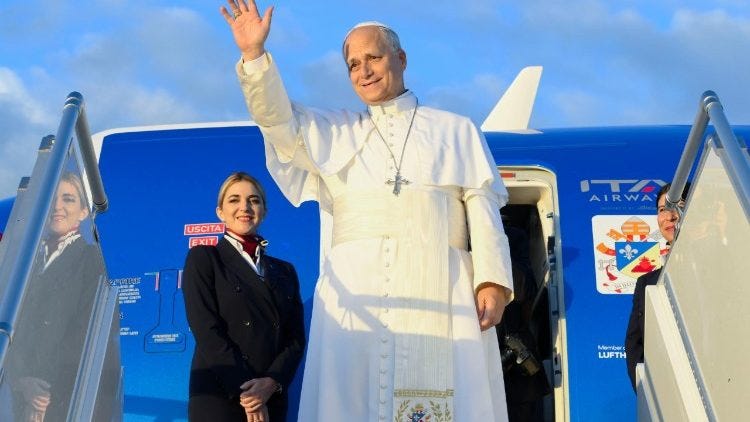
If I had somehow found myself sitting around a table with Pope Leo and his advisers as they planned this visit to France, I think the first question I would have asked would have been a very simple one: what, when the aircraft takes off again at the end of these few days, do we actually want to have achieved?
It sounds obvious, but I think it's the most important question to ask, because a papal visit can very easily become a succession of speeches, meetings, ceremonies and carefully negotiated encounters, all perfectly worthwhile in themselves, but without any single idea being communicated strongly enough to remain in the national imagination once the Pope has gone home. Leo has only a few days in France and his presence there will be really important to a lot of people, but he cannot reverse generations of secularisation, rebuild parish life, restore vocations or address every political and social problem confronting the country, and so I would want to think really carefully about the thing France most needs to hear from the successor of St Peter at this particular moment in its history and return to it throughout the visit.
For me, the leitmotif would be something along the lines of: France, remember who you are, rediscover who man is, and do not be afraid to rediscover God.
I don't mean that as a nostalgic appeal for France to pretend that the last two hundred years never happened, or as some romantic attempt to recreate an imagined Catholic golden age. France is not going back to the thirteenth century, and evangelisation cannot consist in wishing that it might. What I mean is that France has been engaged for a very long time in one of the great experiments of modern European civilisation: the attempt to construct a society in which Christianity becomes progressively less important to the way people understand themselves, their families, their communities and ultimately the purpose of human existence.
The promise underlying that experiment has been enormously powerful. As religious belief receded, we were going to become freer and more rational; ancient moral constraints would fall away; material prosperity, technological progress and individual autonomy would give men and women possibilities their ancestors could scarcely have imagined. We would retain the humanitarian and moral achievements of Christian civilisation while gradually dispensing with the metaphysical claims upon which so much of that civilisation had been built.
If I were Leo, I think I would have the courage to ask France, very gently and without the slightest sense of triumphalism, how that experiment is actually going. Are people happier? Are families stronger? Are young people more hopeful about their futures? Has unprecedented material prosperity satisfied the human longing for meaning? Has sexual liberation produced more secure relationships? Has radical individual autonomy made us less lonely? Has removing God from the centre of our culture made the great questions of suffering, love, death, purpose and human dignity disappear, or have we simply deprived ourselves of the language in which previous generations attempted to answer them? Above all, I think I would ask one question repeatedly, particularly when speaking to young people: what are we telling our children that their lives are ultimately for?
This is where I think the Church has something much more profound to offer modern France than a list of things Catholicism opposes. Christianity offers an account of what a human being actually is, and that account is desperately needed in a culture which increasingly appears confused about the answer.
The Christian claim is that you are not an accidental collection of matter which happens to be conscious for a few decades between birth and oblivion, nor are you simply a consumer whose purpose is to accumulate experiences before death. Your value is not determined by your productivity, intelligence, health, attractiveness, wealth or usefulness to somebody else. You are created deliberately and loved before you achieve anything. Your body has meaning, your freedom has a purpose beyond the satisfaction of appetite, love necessarily involves sacrifice, suffering does not render a life worthless, and the weak and dependent remain infinitely valuable even when they can offer nothing economically useful in return.
Most importantly, Christianity claims that all of this is not simply a comforting philosophy devised to make existence bearable. It rests upon an astonishing historical claim: that God entered His creation in the person of Jesus Christ, suffered, died and rose again, and that consequently neither suffering nor death has the final word. If that were the central argument, I would then use each stage of the French visit to develop another part of it rather than treating every audience as an entirely separate event.
At the Élysée, I would speak about the limits of politics and remind those exercising political power that human dignity is not something bestowed by the state but something the state is morally obliged to recognise. Governments can create laws and institutions, but they cannot manufacture the meaning of human existence, and history should make us extremely wary whenever political authority begins to imagine that the value of human life is something which can be defined according to utility, dependency or circumstance.
At UNESCO, the same argument could be applied to technology and artificial intelligence. The most important question about AI is surely not simply how intelligent our machines can become, but what kind of human beings we are becoming while we build them. Our technological power has developed at an astonishing speed, but capability and wisdom are not the same thing, and a civilisation which continually asks whether something can be done without first developing a coherent understanding of whether it should be done risks becoming immensely powerful without becoming correspondingly wise.
Then there is Notre-Dame, where the argument becomes almost tangible. France magnificently restored that cathedral after the terrible fire of 2019, and the achievement deserves admiration, but Notre-Dame was not built merely because medieval Frenchmen wanted Paris to possess an exceptionally beautiful building. Those stones were raised by generations of people who believed something to be true. The altar, the windows, the sculptures, the orientation of the building and those extraordinary vaults all belong to a coherent Christian understanding of reality. France has demonstrated that it knows how to preserve the monuments of Christian civilisation; the more interesting question is whether it still understands the faith which made those monuments intelligible.
But if I were Leo, it would be the encounter with young people which I would regard as perhaps the greatest opportunity of the entire journey, because I suspect they need something rather more substantial than another general encouragement to hope.
I would tell them that our culture has given them a deeply inadequate definition of freedom. Freedom cannot simply mean keeping every possibility permanently available, because the greatest things human beings ever do require us to close possibilities down. Marriage, parenthood, friendship, vocation and faith become meaningful precisely because we commit ourselves to something beyond ourselves. A person committed to nothing may theoretically remain completely free, but eventually he may also discover that he belongs nowhere and to nobody.
I would tell them that they do not have to spend their lives endlessly constructing an identity from nothing, as though every human being arrives in the world as a blank sheet upon which an entirely autonomous self must be invented. I would acknowledge their loneliness and anxiety rather than dismissing them as the inevitable complaints of youth, and ask whether a culture offering almost limitless digital connection, sexual freedom, entertainment and consumer choice has actually delivered the happiness it promised.
And then, unapologetically, I would tell them about Christ.
Not a carefully diluted Christ translated into the therapeutic vocabulary of the age until there is almost nothing distinctively Christian left, but the Christ who tells the rich young man that possessions cannot satisfy him; who tells the woman at the well that the thirst she is trying to satisfy is deeper than she realises; who tells frightened disciples not to be afraid; who offers forgiveness to sinners; who weeps at the grave of Lazarus and then tells Martha that death is not the end; and who makes the profoundly countercultural claim that the person who spends his life desperately trying to preserve it will ultimately lose it, while the person willing to give his life away may finally discover what life is for.
I would also make Leo's encounter with the catechumens and newly baptised Catholics central to the visit, because something genuinely interesting is happening among young French people. Thousands are approaching the Church for baptism, many of them having grown up without the cultural Catholicism their grandparents would once have taken for granted. Rather than immediately telling them what their conversion means for the Church, I would want the Pope to ask them what they had discovered.
What did you find here that the surrounding culture was unable to give you? What made you walk into a Catholic church when so many previous generations were walking out? What did you encounter in Christianity which persuaded you not merely to admire it but to change your life because of it?
And then I would listen carefully to the answers, because those young converts may understand something about the evangelisation of post-Christian Europe which those of us who inherited Christianity can easily miss.
Finally Leo will go to Lourdes, and I can hardly imagine a better place to bring the argument together. After the presidential palace and UNESCO, after the speeches, diplomatic receptions and intellectual discussion about the future of Europe, the Pope will arrive at a grotto where an impoverished fourteen-year-old girl once knelt in the mud and said she had encountered the Mother of God.
There is something wonderfully subversive about that progression. The modern world instinctively looks upwards towards power, wealth, expertise, celebrity and influence, whereas Christianity repeatedly directs our attention downwards: towards a stable in Bethlehem, towards fishermen, lepers and the poor, towards a man nailed to a Cross and, at Lourdes, towards Bernadette Soubirous kneeling beside a muddy grotto while respectable society wondered whether she had lost her mind.
That is where I think I would want to leave France, not with an accusation but with an invitation to reconsider the direction in which modern European civilisation has been travelling. France has tried extraordinary material prosperity, consumerism, sexual liberation and radical individual autonomy. It has increasingly tried constructing a public culture in which God is unnecessary to the great questions of human existence. It seems perfectly reasonable, after several generations of this experiment, to ask whether it has delivered the flourishing it promised and whether the loneliness, anxiety, demographic collapse and loss of meaning visible across so much of modern Europe might suggest that something essential has been forgotten.
Christianity does not ultimately ask France merely to preserve its cathedrals, admire its saints or remember that its history was once Catholic. Those things matter, but they are not evangelisation. The genuinely unsettling Christian proposition is that the faith which produced so much of the civilisation modern France still cherishes might not simply be historically interesting or culturally useful…It might actually be true.
If I were advising Pope Leo, that is the possibility I would want hanging in the air after he had gone home. I would want a young Frenchman who heard him at the Stade de France, a politician who heard him at the Élysée, an intellectual who heard him at UNESCO and an ordinary family who encountered the visit through television or social media to find themselves returning to the same question. Perhaps the crisis confronting modern France is not simply that it has forgotten part of its history. Perhaps, somewhere along the way, it has forgotten something about what a human being is. And perhaps the answer is not to travel further down the same road, but to turn around and look again at what was left behind.
France, remember who you are, rediscover who man is, and do not be afraid to rediscover God.