


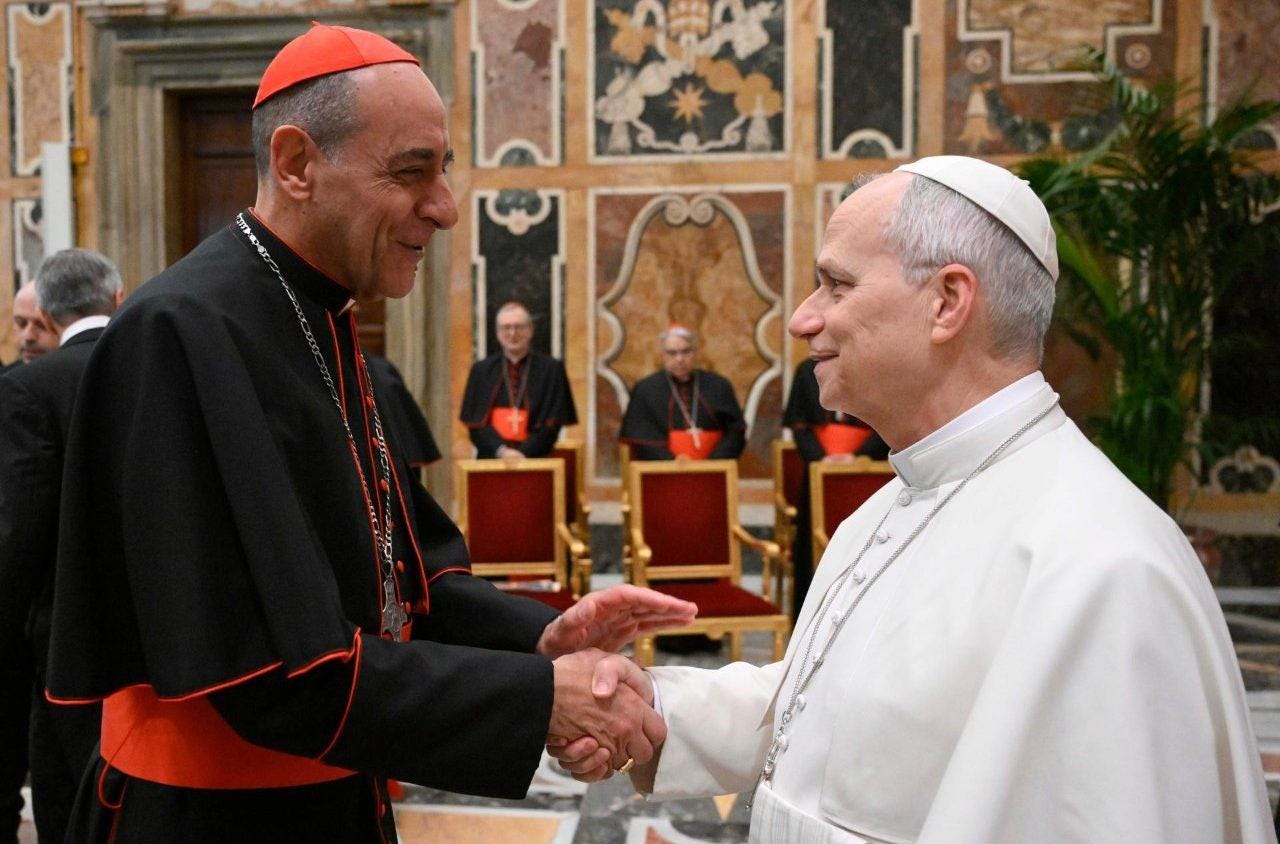
What could be more extraordinary than the sight of posters appearing on the streets of Buenos Aires during a papal visit, calling upon the Pope to dismiss the head of the Vatican’s doctrinal office. The posters, reportedly carrying a QR code directing passers-by to a controversial 2023 sermon by Cardinal Víctor Manuel Fernández, do not in themselves constitute proof of a popular uprising. We do not know who paid for them, how representative their authors are, or whether this modest campaign will have any lasting significance, but their appearance is striking because they coincide with two other developments that cannot so easily be dismissed as simply the agitation of disgruntled traditionalists. A respected veteran Vatican journalist has reported a dispute within the Roman Curia over the legal competence of Fernández’s dicastery, while Cardinal Joseph Zen, the emeritus Bishop of Hong Kong, has openly urged Pope Leo XIV to replace him.
Taken separately, these events have different origins and carry different evidential weight. Taken together, they suggest a problem far more consequential than the unpopularity of one cardinal, they point to a loss of confidence in the intellectual judgement, institutional competence and doctrinal reliability of men occupying some of the Church’s most influential offices. The really interesting question is no longer simply how Pope Francis came to appoint them, it’s why, some eighteen months after his election, Pope Leo has not more decisively addressed the damage to confidence that their continued leadership appears to perpetuate.
In January I argued, in Roche, Fernández and the collapse of competence at the heart of the Church, that a corrosive principle had entered the appointment and promotion of senior Church officials: usefulness was being preferred to excellence. A cardinal was valuable not necessarily because he demonstrated exceptional theological depth, historical judgement or an ability to command the confidence of the faithful, but because he could advance and defend a particular programme. This was an argument about the institutional consequences of appointments rather than a claim that every disputed decision amounted to formal heresy. Nevertheless, a Church that repeatedly promotes men whose public interventions require subsequent explanation cannot help but risk weakening the credibility of the authority it asks Catholics to trust.
Cardinal Zen’s latest intervention brings that concern into sharper focus. In his reflection for the feast of St Charles Borromeo published in English on 6 November, he called for the Synod on Synodality to be brought to an end, suggested that Cardinals Mario Grech and Jean-Claude Hollerich be granted a lengthy holiday, and stated plainly that the head of the Dicastery for the Doctrine of the Faith should be replaced. Zen’s objection is not merely to a style of management, he sees an ecclesiological danger in a synodal process that, in his judgement, obscures the governing responsibility of bishops in communion with the Pope and opens the door to attempts to alter established moral teaching. One need not accept every part of his diagnosis to recognise the significance of an emeritus cardinal publicly urging the reigning Pope to change the leadership of three central figures associated with his predecessor’s programme.
Cardinal Zen drew attention to the unusual letter Francis sent Fernández on appointing him in July 2023. That letter criticised an earlier tendency to pursue suspected doctrinal errors and urged the new prefect to encourage theology capable of engaging the contemporary world. It is important to read it accurately, Pope Francis did not formally abolish the dicastery’s obligation to guard the deposit of faith. The same letter spoke of keeping the faith and required the dicastery’s documents to be coherent with the Church’s perennial teaching. The problem was one of emphasis, expectation and the choice of the man entrusted with carrying it out. An office historically identified with doctrinal precision was given a conspicuously different tone by a Pope who had chosen an intimate theological collaborator to lead it and had developed a pointed reputation for ambiguity and confusion.
