


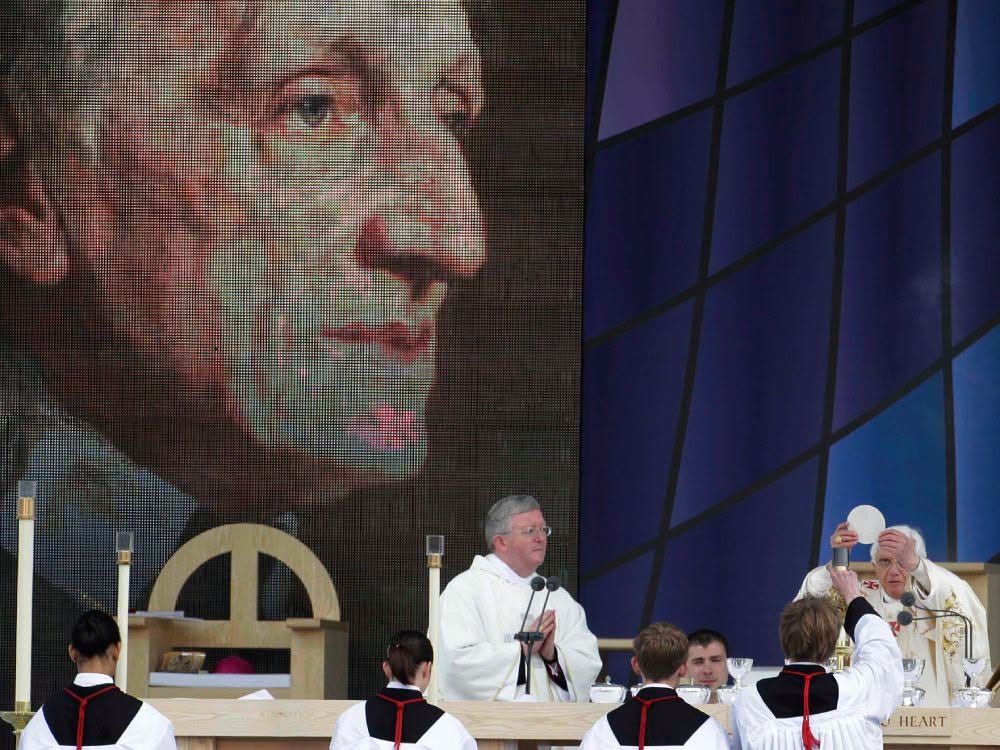
Yesterday’s feast invites us to consider a man whose intellectual greatness lay in his willingness to follow truth wherever it led, even when doing so required him to surrender the position, friendships and security he had built his life around. His reception into the Catholic Church on 9 October 1845 was the costly consequence of that commitment.
St. John Henry Cardinal Newman’s contribution remains invaluable and are especially pertinent in a contemporary context because the questions he confronted have become our questions with renewed urgency. How can the Church grow in understanding while remaining faithful to what she has received? What authority does conscience possess, and what distinguishes its demands from our preferences? How does faith become a living reality rather than a collection of propositions we profess without allowing them to govern us? These questions reach into the present controversies surrounding doctrine, pastoral practice and the confidence of ordinary Catholics.
His chosen epitaph, Ex umbris et imaginibus in veritatem —“Out of shadows and images into truth”—captures the direction of his life. It should be distinguished from his cardinal’s motto, Cor ad cor loquitur, “Heart speaks to heart”. Read together, they offer a beautiful account of the Christian vocation: a journey towards truth which engages the whole person and reaches others through personal love. For each of us, the challenge is whether we are prepared to undertake that journey ourselves. We can become so attached to our preferred account of the Church that we resist anything which requires us to reconsider it. Psychologically, this is recognisable: an interpretation can become bound up with our identity, our friendships and our sense of having understood what others have missed. Contrary evidence then feels threatening and we begin to defend the explanation rather than test it. Newman’s example challenges us to ask whether we are still seeking truth, or have begun protecting ourselves from what discovering it might cost. We live in a moment when it seems some expect every new initiative to vindicate their hopes of doctrinal change; others have developed a suspicion so comprehensive that every appointment, pastoral gesture or unfamiliar phrase becomes evidence of betrayal. Both habits can make the evidence serve a conclusion already reached.
Newman’s work asks for a more disciplined encounter with reality.
His account of doctrinal development addressed a formidable objection to Catholicism. If the faith was entrusted to the apostles, how could the Church legitimately teach with a precision and elaboration absent from the earliest Christian formulations? Did the passage of centuries demonstrate fidelity, or the accumulation of innovations? Newman argued that the later Catholic faith could be understood as the unfolding of what was present from the beginning, rather than its replacement.
That insight gave the Church a powerful way of understanding her history. Revelation is received by human beings who must reflect upon it, defend it against error and articulate its implications in circumstances the first Christians never encountered. A truth can be possessed before all its consequences are recognised. The need for greater precision does not mean that the original gift was defective; it reflects the depth of that gift and the work required to understand it.
The problem is that growth raises the possibility of distortion. To counter this, Newman distinguished development from corruption, proposing seven “notes” through which their difference could be examined. These concern the preservation of a doctrine’s identity and principles, its capacity to assimilate, its logical unfolding, its anticipation in earlier belief, its conservation of the past and its enduring vigour. His method requires us to examine the relationship between a proposed development and the faith from which it claims to grow.
This is why his much-quoted observation that “to live is to change, and to be perfect is to have changed often” cannot responsibly become a slogan for whatever alteration we happen to desire. Its setting is an argument about the life and development of ideas. The existence of change does not establish its legitimacy; the question remains whether an idea is being brought to fuller expression or losing its identity. Remember Newman’s epitaph because it can be our guide here: Ex umbris et imaginibus in veritatem. It shows us that for Newman, the Christian life was a pilgrimage towards reality itself. We live in a world of shadows and images, where our understanding is necessarily partial, our judgements imperfect and our vision obscured by the limitations of human experience. Yet beyond these shadows lies the fullness of Truth, not an abstract philosophical proposition, but a Person: Jesus Christ.
My friend the Rev Dr Stephen Morgan (one of the leading Newman scholars in the world today) makes this central distinction in his essay, “Hijacked Development”. In it he challenges appeals to Newman which, in his judgement, provide cover for reversals of moral teaching, particularly in arguments surrounding Amoris Laetitia and Fiducia Supplicans. His warning deserves serious attention: invoking Newman does not relieve anyone of the obligation to demonstrate continuity. Nor can pastoral practice be treated as though it has no bearing on what the faithful understand the Church to teach.
