


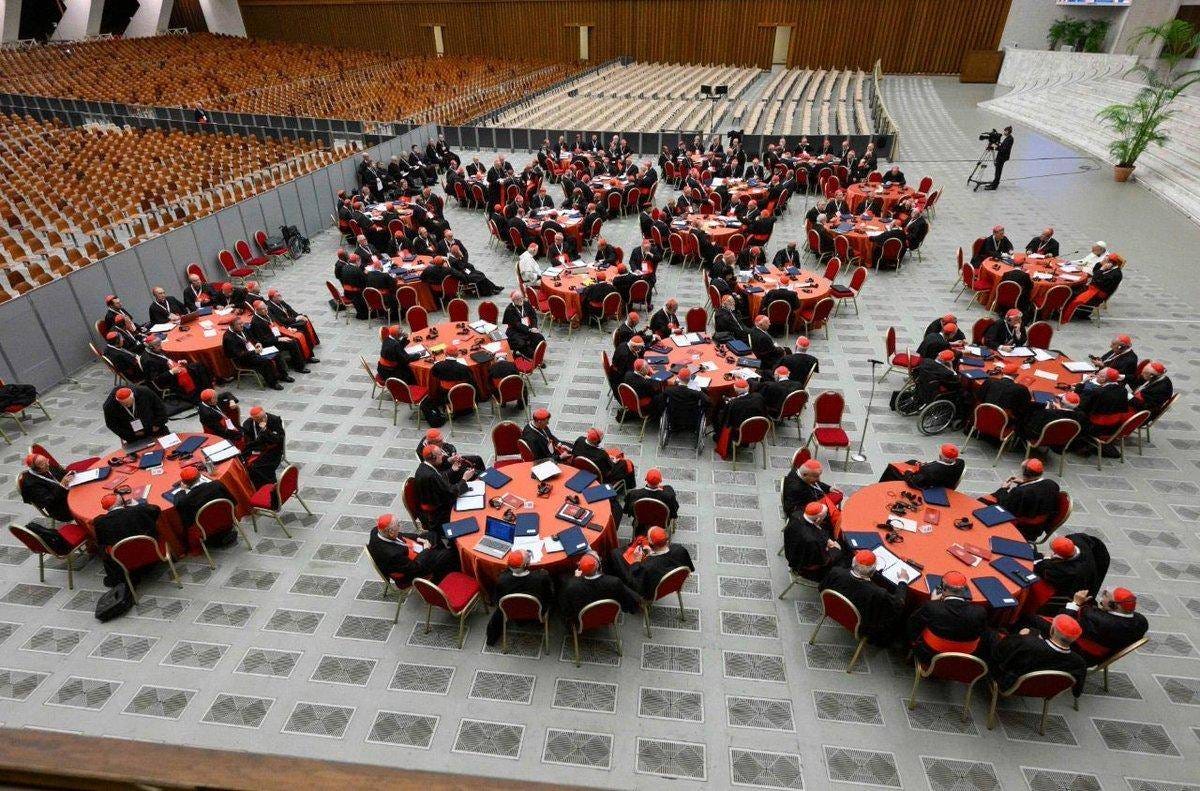
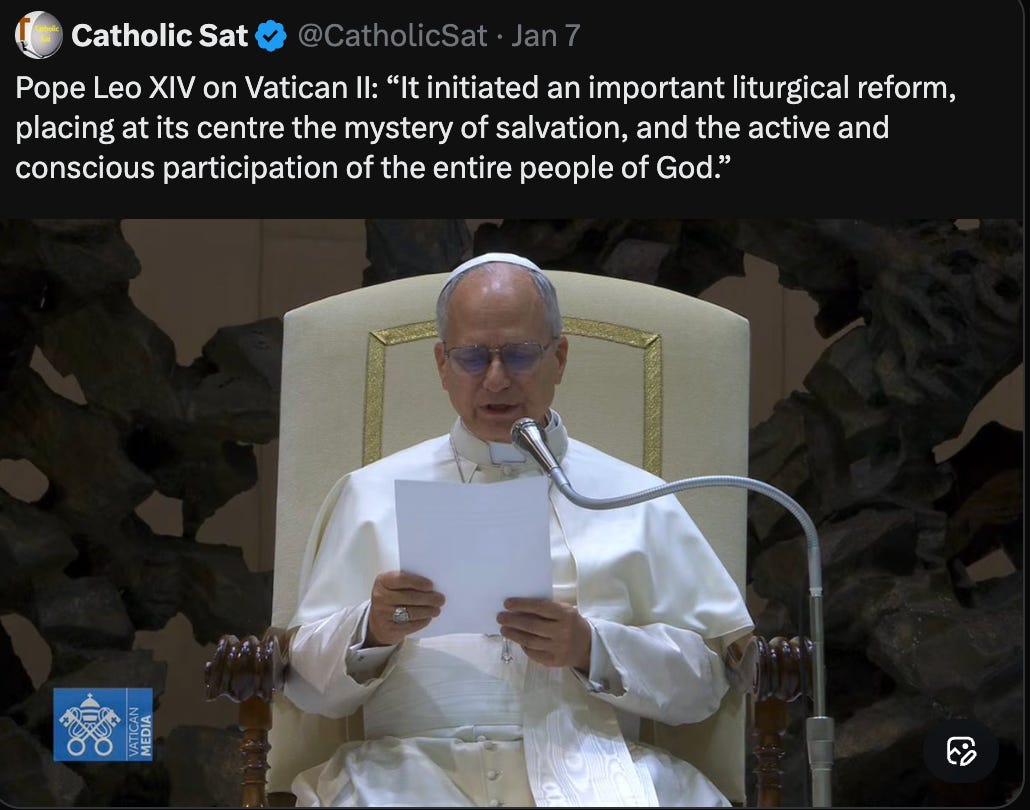
What has unfolded during Pope Leo XIV’s first extraordinary consistory has already revealed more than any formal communiqué could hope to convey. As I have already mentioned in my last post on this, the agenda is framed in the familiar post-Francis lexicon of synodality, reform, and Vatican II. The Pope’s general audience catechesis, choosing Vatican II as its subject and highlighting liturgical reform and active participation, was a disappointment I have to admit. One can surmise that, on paper at least, this is aimed to speak to a hermeneutic of continuity. In substance, however, it risks reopening precisely the fault lines that many Catholics hoped this pontificate might finally begin to heal.
The risk is not that Vatican II will be mentioned, still less that its legitimate teaching will be reaffirmed. Let us hope that is the case! The danger lies in the way the Council is being positioned once again as the primary interpretive horizon for the Church’s present and future. For a growing number of Catholics, particularly younger ones, Vatican II no longer functions as a source of renewal but as a symbol of institutional exhaustion. It is perceived not as living memory but as old news, endlessly invoked to justify instability. As Dr Peter Kwasniewski has observed with brutal clarity, if active participation were measured simply by presence, then the catastrophic emptying of churches in the decades following the Council and the reform that followed it would have to count as a profound failure even by the reform’s own criteria. Meanwhile, parishes where the traditional Roman Rite survives are often marked by large families, vocations, and an unmistakable sense of seriousness about the faith. This empirical reality cannot be wished away by rhetorical appeals to conciliar ideals.
Pope Leo’s apparent decision to frame this decisive week explicitly through Vatican II therefore carries real pastoral risk. On the one hand, Vatican II is a reality, a part of Church history that has happened and speaks loudly to the present situation in the Church. However, making it once again a focal point may unintentionally reinforce the impression that the Church remains navel-gazing, trapped in a mid-twentieth-century debate whose categories no longer persuade those who are most invested in her future. This is especially true given the unresolved liturgical conflict unleashed by Traditiones Custodes and its subsequent clarifications. Hopes that the consistory might address these wounds were always tentative, but they were real and vocally expressed before discussions began. The Pope’s own words on Vatican II’s liturgical reform, stressing participation without reference to the collapse of reverence or the loss of mystery so widely lamented, have unsettled those hopes:
Despite this the actual situation is more complex than a simple continuity narrative would suggest. Reporting from the consistory itself reveals a quieter undercurrent of concern even among cardinals not remotely associated with traditionalism. One senior cardinal remarked that liturgical abuses have hollowed out the sense of mystery at Mass and noted that the Pope’s pastoral experience in Latin America gives him firsthand knowledge of how uninspiring the liturgy can become when reduced to functionalism. Cardinal Jean-Claude Hollerich, no conservative, openly entertained the possibility of greater flexibility for the traditional Mass. Such comments strongly suggest that even figures shaped by the “Spirit of Vatican II” now recognise the injustice and pastoral harm caused by Pope Francis’s reversal of Summorum Pontificum.
