


There is no doubt that there is something profoundly attractive about the language of ecumenism, it certainly speaks to much of the sentiment of the modern age. Also, Christians ought to desire unity, the spectacle of those who confess Jesus Christ divided from one another is undoubtedly a horrendous wound in the Christian witness to the world. And let’s not forget that Christ Himself prayed that His disciples might be one (John 17) a theme taken up in Pope St. John Paul II’s encyclical letter, Ut Unum Sint (1995), “On Commitment to Ecumenism” which, essentially recognises the presence outside visible Catholic communion of genuine Christian realities, but immediately explains:
“All of these, which come from Christ and lead back to him, belong by right to the one Church of Christ.” (§13).
Pope St. John Paul II is quite explicit that the destination is full communion, not indefinitely increasing fraternity. His later explanation of Ut Unum Sint describes ecumenism as making the existing “partial communion” grow towards “full communion in truth and charity.” The Second Vatican Council therefore did not invent the desire for Christian unity, but acknowledged am existential and developing reality and gave renewed urgency to something which belongs to the nature of the Church herself. The preconciliar expression shows this was the direction of travel. In 1928, Pope Pius XI’s Mortalium Animos (1928) is explicitly “On Religious Unity” and was written partly in response to the emerging ecumenical movement. Pius XI's central concern is remarkably relevant to the utter nonsense we see being currently pushed out by the Synod Secretariat: he rejects the idea that Christ's Church should be imagined as presently divided into several roughly equivalent Christian bodies which must somehow come together to create the unity Christ intended. The particularly striking passage is §7. Pius XI identifies as erroneous the belief that the unity of Christ’s Church:
“does not to-day exist”
and the related conception that the Church is composed of various separate Christian communities which must eventually be reunited. Unity really matters and it is precisely because unity matters, that we have to be rather careful about what we mean by it.
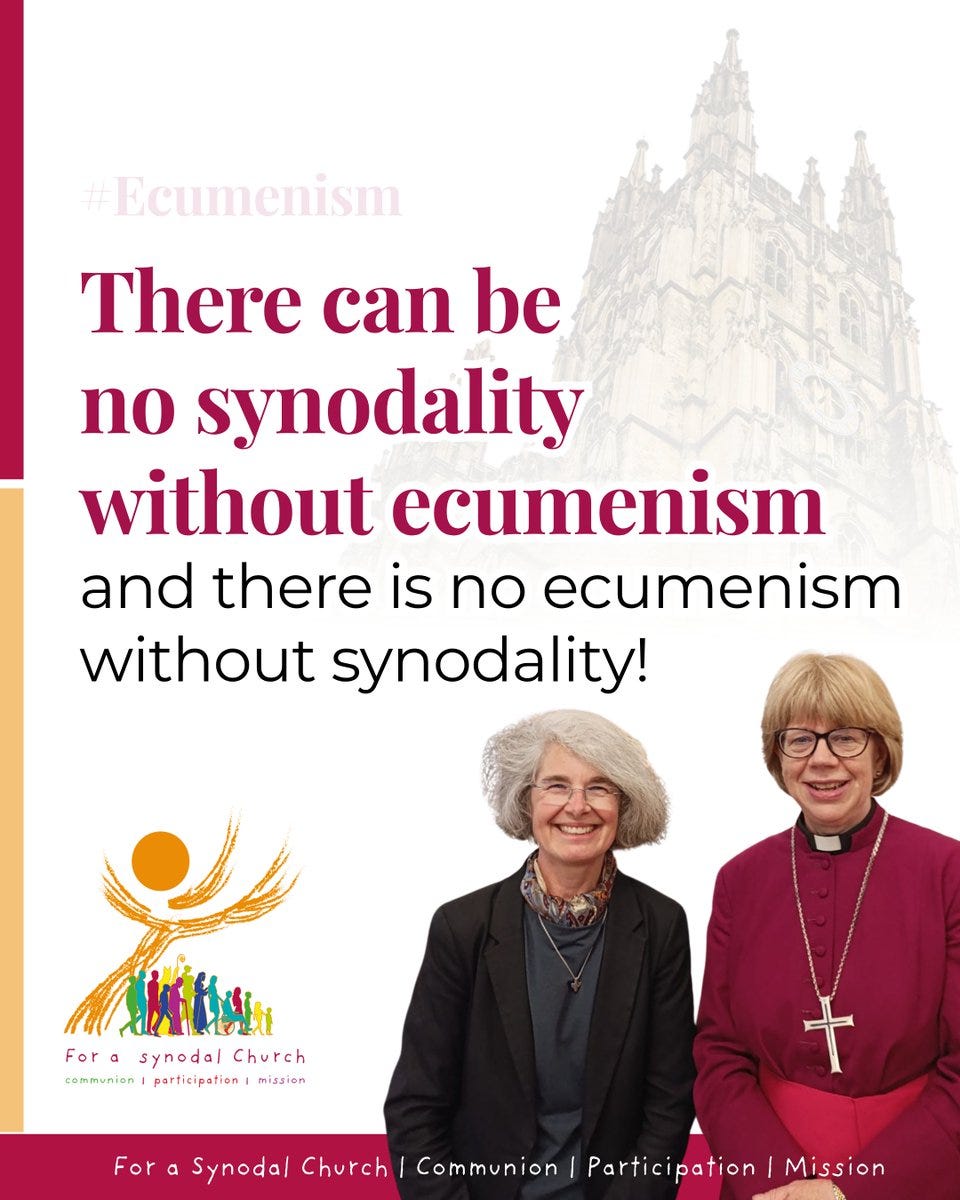
The General Secretariat of the Synod recently published a striking claim on its social media account: “There can be no synodality without ecumenism, and there is no ecumenism without synodality.”
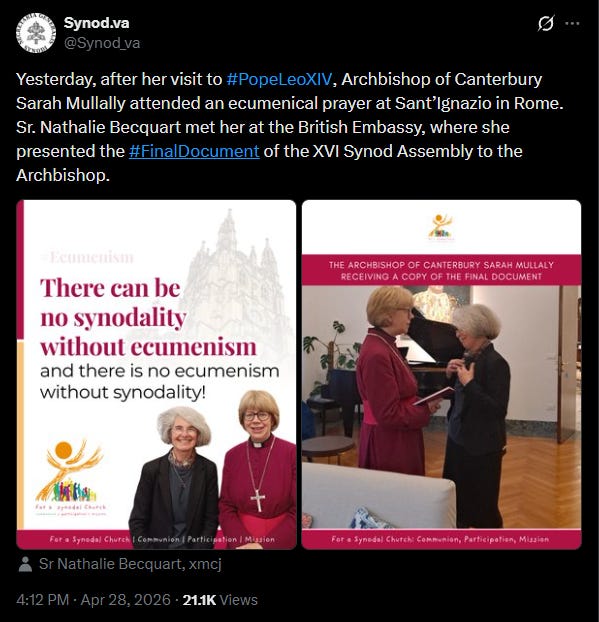
You might argue that, at first sight at least, it seems characteristically harmless. Who could object to Christians walking together? Who could object to listening, dialogue, fraternity and the search for reconciliation? The difficulty begins when we ask a very Catholic question: the question we seem to have to repeatedly ask when it comes to this whole synodality project - walking together towards what?
The Secretariat’s post is not an isolated piece of enthusiastic social media. It reflects an ecclesiological idea which has been developing throughout the Synodal Process. Back in 2021 the General Secretariat and the then Pontifical Council for Promoting Christian Unity explained that synodality and ecumenism are both processes of “walking together”. More revealingly, they described ecumenism as an “exchange of gifts” in which Catholics might receive from other Christians their “experience and understanding of synodality”. The Instrumentum Laboris subsequently developed this considerably further. It declared that through the one Baptism “all Christians participate in the sensus fidei”, proposed the ecumenical movement as a “laboratory of synodality”, suggested that Catholic synodality could learn from ecumenical methods of dialogue and consensus building, and spoke of Christians participating in one another’s synodal processes. More recently, the Secretariat has gone so far as to say of participation by other Christians in the Catholic synodal process: “They can, and they must.”
There is, of course, just enough recognisably Catholic language here to permit those arguing for an orthodox interpretation to gain a tenuous foothold, that is precisely what makes the formulation so troubling. Compare the Secretariat’s nebulous language of “walking together”, “exchange of gifts” and reciprocal learning with the almost forensic theological precision of Unitatis Redintegratio, Ut Unum Sint and Dominus Iesus. The older Magisterial texts carefully distinguish the Church of Christ from ecclesial communities separated from her, Churches from ecclesial communities, full communion from imperfect communion, genuine elements of sanctification from the fullness of the means of salvation and the legitimate reception of what is authentically Christian in separated communities from any suggestion that the Church herself remains to be constructed through their convergence. Pope John Paul II could hardly have been clearer: ecumenism is “not a matter of adding together all the riches scattered throughout the various Christian Communities in order to arrive at a Church which God has in mind for the future.” The Church is, he insists, “something already given”, and ecumenism therefore seeks to bring an existing but imperfect communion towards “full communion in truth and charity”. The contrast with the Secretariat’s language is striking. The old precision has been replaced by formulations sufficiently Catholic-sounding to escape immediate censure, yet sufficiently indeterminate to leave unanswered precisely those ecclesiological questions the Magisterium once considered essential. What Church are we walking towards? Where does the fullness of that Church presently subsist? What distinguishes a “gift” to be received from an error to be rejected? What is the relationship between separated Christians and the visible Catholic Church? These are not pedantic qualifications, they foundationally constitute the Catholic theology of ecumenism and their disappearance into the therapeutic vocabulary of listening, reciprocity and journeying is therefore not theological development but theological impoverishment. It is difficult not to see here another consequence of the extraordinary ecclesiastical ascendancy, particularly under Pope Francis, of figures for whom doctrinal precision appears less an indispensable servant of communion than an inconvenience to be negotiated around. It is increasingly difficult to pretend that that tendency was not consciously intended to subvert settled Catholic teaching. What we can say is that its effect has been increasingly to obscure distinctions which previous Popes and the Magisterium went to considerable lengths to define and defend.
Vatican II unquestionably teaches that Christians who have received valid baptism possess a real relationship with the Catholic Church. They are not simply outsiders. They are in an imperfect communion with her. The Council also teaches that elements of sanctification and truth exist beyond the Church’s visible boundaries and that Catholics can genuinely learn from the holiness, witness and Christian experience of separated brethren. Indeed, this was precisely the subject of an essay I wrote many years ago while studying theology. What fascinated me then, and continues to fascinate me now, was the theological sophistication of the Council’s idea of degrees of communion.
Communion is not binary in quite the simplistic way we sometimes imagine it to be. A validly baptised Protestant has a genuine bond with the Catholic Church. An Orthodox Christian possesses more visible elements of ecclesial communion because the Orthodox Churches retain apostolic succession, a valid priesthood and the Eucharist. The Council consequently speaks of them as true particular Churches. Protestant communities which have not preserved apostolic succession and the Eucharistic mystery do not possess the same degree of ecclesial reality and therefore, in precise Catholic terminology, are not “Churches” in the same sense. This is not an exercise in ecclesiastical point scoring, it is important because it tells us something extraordinarily important about what ecumenism actually is.
The elements of sanctification and truth found outside the visible boundaries of Catholicism are not fragments of Christianity which the Catholic Church herself has lost and must retrieve from other denominations. Lumen Gentium describes them as forces tending towards Catholic unity. They belong, in other words, to the patrimony of Christ’s Church and derive their salvific efficacy from the fullness entrusted to the Catholic Church. They attract those separated brethren to the One True Church and, when we abandon them, in truth, we also abandon true ecumenism for the sake of a “niceness” which has no real value or meaning beyond platitude.
This is why the apparently innocuous language employed by the Synod Secretariat begins to trouble me. The impression increasingly given is not of separated Christians possessing different degrees of communion with the one Church founded by Christ, but of different Christian traditions walking alongside one another, exchanging gifts, mutually correcting and enriching one another as they journey towards a unity which lies somewhere ahead of all of them, but that is not Catholic ecclesiology. As we have seen from our extremely peripheral analysis of the Magisterial texts, the Catholic Church does not believe that the Church of Christ is a future construction. She does not believe that Catholicism, Orthodoxy, Anglicanism, Lutheranism and Methodism are fragments from which the Church of Christ must eventually be reassembled. She does not believe that the unity for which Christ prayed disappeared and now awaits rediscovery through an ecclesiastical process of synthesis.
This was precisely the ambiguity which Dominus Iesus sought to eliminate. It stated that Christians may not imagine the Church of Christ as a collection of divided Churches and ecclesial communities, nor suppose that the Church of Christ does not presently exist and remains merely a goal towards which the denominations must journey. There is one Church of Christ and that Church “continues to exist fully only in the Catholic Church”. Not triumphalism, this is Catholicism! And it establishes the essential grammar without which ecumenism becomes unintelligible.
The destination of authentic ecumenism cannot simply be a vague and meaningless “unity”. The destination is full communion in the one Church Christ founded. The Catholic Church certainly needs purification and Catholics need conversion, indeed, Bishops need conversion, Popes need conversion and in this we can learn from the missionary fervour of Evangelicals, the liturgical seriousness of the Orthodox, the scriptural devotion of Protestants and even from institutional practices developed outside Catholicism. To dismiss them is unwise and ignores reality and Christ’s words in Sacred Scripture. But the Church cannot learn from another community a different answer to something Christ has definitively revealed. Truth cannot be received as an “ecumenical gift” when it contradicts the deposit of faith.
That distinction became painfully obvious during the recent Vatican visit of Sarah Mullally. The official language spoke warmly of dialogue in “truth and love”. Yet what does truth require us to say about Anglicanism? Leo XIII definitively judged Anglican orders to be null. John Paul II taught that the Church has no authority whatsoever to ordain women. The Anglican Communion has nevertheless proceeded not only to ordain women as priests, but to consecrate them as bishops and now presents a woman as Archbishop of Canterbury. As I stated at the time, the problem is not that Pope Leo met Sarah Mullally, of course he should meet her. Courtesy is not in any way objectionable, Christian charity demands courtesy. The question is whether our ecumenical language still possesses sufficient theological content to describe reality.
As I argued at the time of that meeting, unity in Catholic thought is theological before it is relational. It is grounded in truth and expressed sacramentally. If the language of unity quietly brackets the very doctrinal differences which prevent unity, what remains may be excellent diplomacy, but it is difficult to see how it remains ecumenism in the properly Catholic sense. And then we encounter the elephant sitting rather awkwardly in the ecumenical room: the Society of Saint Pius X. I want to be careful here because I do not accept the SSPX’s justification for its decision to consecrate bishops against the explicit prohibition of Pope Leo XIV. Whatever one thinks of the post-conciliar crisis, episcopal consecration is not merely a private act of sacramental devotion, it is an intrinsically ecclesial act. The Holy See consequently declared the bishops involved excommunicated following the consecrations of 1 July. But precisely because I believe communion with Peter matters, the contrast is becoming impossible to ignore. Consider the strange ecclesiastical landscape before us:
The Vatican can speak enthusiastically about receiving “gifts” from Christian communities which reject Catholic doctrines concerning the Eucharist, Holy Orders, ecclesiastical authority, sexual morality and, in some cases, the sacramental nature of the Church itself. Christians belonging to these communities are invited into Catholic synodal processes because, we are told, “all Christians participate in the sensus fidei”. Their experience may even help Catholics discover how the Catholic Church herself ought to become more synodal.
Yet Catholics attached to the SSPX profess the Nicene Creed, accept the seven sacraments, possess valid priests and bishops, celebrate a valid Eucharist, profess belief in the Real Presence, invoke the Blessed Virgin and the saints, accept the sacrificial nature of the Mass, adhere to the Catholic moral tradition and profess, however inconsistently their actions may sometimes seem to demonstrate it, the primacy of the Roman Pontiff.
Why is it that the Vatican’s language suddenly changes? Walking together gives way to rupture, dialogue gives way to canonical penalties, the “exchange of gifts” becomes an excommunication decree. Vatican News described the SSPX consecrations as a “schismatic” act and emphasised that, although the Society claimed to recognise Pope Leo’s authority, its actions disregarded his explicitly expressed will. That criticism is not unreasonable. Authority has consequences and communion with Peter cannot merely be theoretical, but surely communion has consequences in the other direction too? If Catholic ecclesiology genuinely recognises degrees of communion, then one has to ask an uncomfortable question. On almost every objective sacramental and doctrinal criterion identified by Vatican II, is the SSPX not substantially closer to full Catholic communion than the Church of England?
This is not an argument for ignoring the canonical situation of the Society. It is an argument for applying our ecclesiology consistently, and it exposes the extraordinary incompetence which is all too easy to recognise at the top echelons of the Catholic Church at present.
There is something profoundly strange about an ecclesiastical culture capable of displaying almost inexhaustible creativity when describing the communion enjoyed with Christians who reject substantial portions of Catholic doctrine, while speaking almost exclusively in juridical categories about traditional Catholics whose rupture concerns precisely their relationship with ecclesiastical authority. One group may deny Catholic teaching and nevertheless be approached principally through the language of gifts. The other may affirm almost the entire Catholic doctrinal and sacramental system but resist papal authority and be approached principally through the language of rupture, of course, both of these realities matter.
This is where “degrees of communion” becomes much more than an interesting theological abstraction. The SSPX crisis actually demonstrates why Vatican II’s ecclesiology is useful: communion possesses doctrinal, sacramental and juridical dimensions. The Society’s wound is overwhelmingly located in the last of these, although its underlying doctrinal disputes cannot simply be dismissed. Anglicanism, by contrast, suffers profound ruptures in sacramental, doctrinal and juridical communion. To recognise this fact does not excuse the SSPX, rather it locates the problem accurately and accurate diagnosis is surely a prerequisite for genuine reconciliation.
There is another irony here. The Synod’s Final Document proposes “mutual accountability for who we are, what we do, and what we teach” between Christian communities, that is an extraordinary phrase. If it means that Christians should lovingly challenge one another to greater fidelity to Christ, it could be tremendously fruitful. But Catholicism must surely bring something distinctive to that conversation. It cannot enter the room pretending that the Catholic Church and the ecclesial communities created by the Reformation stand in symmetrical relationships to the Church of Christ, they do not! Catholic ecumenism begins with an apparent paradox. We can acknowledge genuine Christian holiness outside visible Catholic communion precisely because we believe so strongly in the objective reality of the Church. Baptism really does something, the Eucharist really is something, Apostolic succession really matters, Holy Orders really matter, doctrine really matters, Communion with Peter really matters. Without these fundamentals, the whole of Christ’s revealed truth begins to fall apart. I have seen this first hand by working with and in Protestant communities. These realities allow us to speak of degrees of communion because communion has an objective content. Remove that content and “communion” becomes little more than friendliness.
Perhaps this is the deeper danger in the Secretariat’s formulation. The problem is not that it speaks too warmly about other Christians, Catholics should speak warmly about them. Nor is the problem that we might learn from them, humility requires us to recognise goodness wherever the Holy Spirit has brought it forth. The danger arises when ecumenism ceases to have a discernible direction. If everyone is simply walking together, the obvious question remains: where are we walking? If everyone is exchanging gifts, we must ask: according to what criterion do we distinguish a gift from an error?
If everyone possesses the sensus fidei by virtue of baptism, how does that claim relate to separation from the Church’s sacramental and teaching authority? It just becomes meaningless! If the Church must listen to the ecclesial experience of communities which have abandoned apostolic succession, rejected Catholic teaching and reconstructed Christian morality according to contemporary culture, what exactly is the theological status of what she hears? And if synodality requires us to listen attentively to Christians separated from Rome by five hundred or a thousand years, ought it not also compel an extraordinarily patient effort to listen to Catholics whose estrangement from Rome is measured in decades and whose churches still contain the same altar, the same tabernacle, the same priesthood, the same sacraments, the same Creed and the same sacrifice of the Mass?
There’s an inherent irony in the fact that these two realities exist at the same time in the Church: the Church’s contemporary vocabulary of inclusion is being tested by one of the most difficult cases imaginable. Perhaps the great challenge facing Catholic ecumenism is therefore not choosing between truth and charity, that is a false dichotomy. Charity without truth becomes sentimentality, while truth without charity becomes a weapon. The challenge is to recover the profoundly Catholic idea that truth itself creates communion.
This is why the Council’s teaching about degrees of communion is so much richer than the vague assertion that we are all “walking together”. It tells us both why we are already related and why we are still divided. It allows Catholics to embrace separated Christians without pretending that separation does not matter. It allows us to recognise sanctification outside the visible boundaries of the Church without pretending that all ecclesial communities are equivalent…And it gives ecumenism a destination. The purpose of ecumenism cannot ultimately be to make separation more comfortable. It must be to overcome separation. Otherwise we risk arriving at a curious inversion of the Gospel imperative: endless dialogue with those moving progressively further from Catholic faith and progressively sterner discipline for those who, whatever their grave errors of judgement, insist that they are trying to preserve it.
The Secretariat tells us that there can be no synodality without ecumenism and no ecumenism without synodality. One has to wonder why not? Would synodality cease to exist because there was no longer an ecumenical problem? Obviously the answer is that it wouldn’t. Or go backwards, was the Council of Jerusalem in Acts 15 not synodal because there was no Anglican Communion, Lutheran Church or Eastern Orthodox communion with which the Apostles were engaged ecumenically? Was Nicaea not an exercise of synodality? The proposition therefore cannot literally be true.
It is certainly the case that there can certainly be neither authentic synodality nor authentic ecumenism without truth. And the truth is not something we shall eventually discover at the end of the journey.
The Truth is the One who called us to walk in the first place.
Thanks Mark. I agree 100%. The strategic ambiguity that began in the 60’s is coming to full flower in synodality and it is dangerously subversive of orthodox Catholicism. They tiptoe around and bow toward doctrine while contradicting it the name of mercy and pastoral care. Calling attention to the irony (hypocrisy) regarding the treatment of the SSPX should not be ignored. The irony becomes absurdity and perhaps reveals a more subversive dynamic at play.
"The Truth is the One who called us to walk in the first place."
Thankyou for this article Mark. It has helped me to better understand the bewildering language at play in the strange synodal-ecumenical complex.
Ave Crux. Spes Unica!